In today’s tightly scheduled world, remembering countless passwords and PINs can feel like a never-ending struggle. But there is a way that is simpler and more secure.
Voice recognition technology offers a solution to protect your personal information, turning your unique voice into the ultimate key to your digital life.
No more frustration, no more fear of forgetting, just a quick, secure authentication process that recognizes you based on the sound of your voice.
This technology makes online security not only easier but also more reliable.
As security threats grow, finding a solution that’s both effective and easy to use is important.
This blog covers what voice biometrics is, how it works, and its basic principles, including voice pattern recognition and authentication technology.
What is Voice Biometrics?
Voice biometrics is a security technology that identifies and verifies a person using unique characteristics of their voice, such as pitch, tone, rhythm, and speech patterns. During enrollment, the system creates a voiceprint, a digital profile built from voice samples. When the user speaks later, the system compares the new voice sample with the stored voiceprint to confirm identity. Because every voice has distinct acoustic traits, voice biometrics is widely used for secure authentication in banking, customer service, healthcare, and smart devices.
This voiceprint authentication technology is an innovative security method that uses the unique characteristics of a person’s voice to identify and authenticate their identity.
Unlike passwords or PINs, it relies on vocal traits such as pitch, tone, and speech rhythm.
Each individual’s voice is as distinct as their fingerprint, shaped by the vocal tract, pronunciation, and other personal speech patterns.
This makes it highly accurate and difficult to replicate. Compared to traditional authentication methods, it offers a smoother and more user-friendly experience.
It is an increasingly popular choice across a range of applications, from banking to customer service, providing a convenient alternative to traditional security methods.
How Voice Biometrics Works?
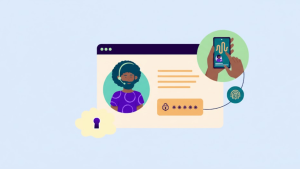
It works by first enrolling a person’s voice to create a unique voiceprint, a digital profile generated from multiple voice samples.
These samples capture key vocal traits like pitch, rhythm, tone, and frequency, which are distinct to each individual.
The voiceprint is securely stored in a system’s database, protected by encryption to prevent unauthorized access and ensure privacy.
When a user speaks, the system extracts these vocal features, analyzing them to create a precise template. This template is then compared to the stored voiceprint.
The system calculates a matching score based on how closely the live speech matches the stored template. If the score exceeds a certain threshold, the identity is verified.
This process ensures that only authorized users can gain access, offering a highly secure and efficient authentication method for both individuals and organizations.
Types of Voice Authentication Systems
Voice authentication technology has advanced to provide various secure systems that use different methods to capture unique voice features and verify identity, for diverse security needs.
1. Text-Dependent Voice Biometrics
Text-dependent biometrics requires users to speak a specific phrase or sentence during enrollment and authentication, working as an active voice authentication.
The system records these exact phrases to create a unique voiceprint, which it uses to verify the identity of the speaker each time they log in or access an account.
This method focuses on the vocal patterns associated with the specific words or phrases used.
It is reliable but requires users to repeat the same phrase each time they are authenticated.
Best used in: Secure applications like banking or call centers, where consistent phrases can be used for verification.
2. Text-Independent Voice Biometrics
Text-independent biometrics doesn’t rely on fixed phrases; it uses passive-voice authentication.
It uses the natural patterns of a person’s speech, capturing how they speak in everyday conversation.
This method records a person’s unique vocal traits, such as tone, pitch, and rhythm, to create a voiceprint.
Because the system does not require a specific phrase, it offers more flexibility, allowing users to speak naturally for verification, making it easier to use in real-world scenarios.
Best used in: Smart devices, virtual assistants, or anywhere a natural conversation might occur.
Basic Principles Behind Voice Biometrics

The key technology behind it relies heavily on advanced AI and machine learning.
AI helps analyze voice patterns by extracting unique features like pitch, tone, and rhythm, making it easier to identify and verify individuals.
It also improves the system’s ability to adapt to changes in a person’s voice, such as aging or temporary conditions like a cold.
Machine learning algorithms continually learn from new data, increasing the system’s accuracy over time. Liveness detection and anti-spoofing measures are essential to ensure security.
These techniques help prevent attacks like replay or the use of synthetic voice deepfakes, ensuring that only live, genuine voices are accepted.
By combining these technologies, it offers a secure, reliable, and adaptable authentication method for modern security systems.
Common Uses of Voice Biometrics
This technology is being adopted across various industries to simplify authentication processes. By using a person’s voice, organizations can provide a secure way to verify identities.
- Healthcare Authentication: Used to verify patient and provider identities, securing access to medical records without passwords or IDs.
- Legal Sector: Lawyers and professionals use this technology for secure access to sensitive case files and documents.
- Government Services: Applied by government agencies to securely identify citizens and simplify access to services.
- Workplace Security: Employers use these biometrics for accessing secure areas, allowing employees to authenticate themselves quickly.
- Telecommunications: Telecom companies employ this technology to authenticate customer accounts and prevent fraud.
Speech Recognition vs Voice Biometrics
These are the two distinct technologies that both utilize voice for different purposes, best suited to specific needs in various applications, for improving user interaction in everyday tasks.
| Feature | Speech Recognition | Voice Biometrics |
|---|---|---|
| Purpose | Converts spoken language into text for understanding. | Identifies or authenticates a person based on their voice. |
| Primary Use | Used for voice commands, transcription, or interaction. | Used for security and identity verification. |
| Accuracy | Accuracy depends on context and speech clarity. | Based on unique voice features like pitch, tone, and cadence. |
| Security | Less secure, can be vulnerable to background noise and voice variations. | Highly secure, relies on unique voiceprints and liveness detection. |
| Interaction Style | Requires the user to speak specific words or commands. | Identifies users based on natural speech or specific phrases. |
Benefits of Voice Biometrics
This technology offers a range of benefits, making it an increasingly popular choice for identity verification and security across industries and providing a seamless way to authenticate users.
- Enhanced Security: It uses unique vocal traits that are difficult to replicate, offering high-level security for sensitive data and systems.
- Convenience: Users can authenticate with just their voice, eliminating the need for passwords or PINs and providing a hassle-free experience.
- Faster Authentication: This technology enables faster identity verification, reducing wait times compared to traditional methods like passwords or security questions.
- Fraud Prevention: Advanced systems with anti-spoofing measures help prevent fraud, ensuring that only genuine voices are authenticated.
- Non-Intrusive: The process is quick and doesn’t require physical interaction, making it ideal for hands-free environments and mobile applications.
Limitations of Voice Biometrics
These limitations highlight the need for a balanced approach that combines these biometric technologies with other advanced security methods for optimal protection and reliable results.
- Vulnerability to Background Noise: Accuracy can decrease in noisy environments where background sounds interfere with voice recognition.
- Voice Changes Due to Illness or Aging: Illness, aging, or stress can change a person’s voice, affecting verification accuracy.
- Limited by User Participation: Certain systems require users to speak specific phrases, which can be inconvenient or difficult.
- Privacy Concerns: Storing voiceprints raises privacy issues, as sensitive biometric data could be targeted in breaches.
- Susceptibility to Spoofing: Despite anti-spoofing technology, it can still be vulnerable to deepfakes and voice-replay attacks.
Voice biometrics continues to change how we think about security, making authentication simpler and more reliable while addressing growing concerns about privacy and fraud.
Conclusion
Voice biometrics is an innovative technology that uses the unique characteristics of a person’s voice to validate identity.
By analyzing features like pitch, tone, and rhythm, it offers a secure, convenient alternative to traditional authentication methods such as passwords and PINs.
As security concerns continue to grow, this technology is becoming increasingly important in fields ranging from healthcare to telecommunications, providing a reliable solution.
With its ability to prevent fraud and streamline authentication, it is poised to revolutionize digital security.
As you find new ways to protect sensitive data, consider integrating this type of biometric into your security strategy to enhance protection and deliver a seamless user experience.
Do you think this technological advancement is the future of secure authentication? Share your opinion and thoughts in the comments below.